Student Design Exhibition Supports Neighborhood Resilience
Joshua Gaddy, a Kansas State University architecture student, spent the fall 2025 semester studying at the Kansas City Design Center (KCDC). The design he created for Kansas City’s Dunbar neighborhood — as well as designs by 17 other fourth-year Kansas State University students participating in the program — is on display at the Central Library through January 30.
He and his classmates all worked toward the goal of increasing the resilience of that particular neighborhood, the city’s first Black suburb and producer of nearly 90% of the flowers sold in Kansas City, which earned it the nickname the Garden of Eden.
They designed spaces, devices — anything — to better allow residents to anticipate, withstand, adapt, or recover from social, environmental, or economic shocks.
The proposals, Gaddy says, address “a lot of the issues facing the Dunbar neighborhood in Kansas City, Missouri, like the food desert with the local closure of their closest grocery store, the disinvestment, and the lack of resources for the community over the past decade.”
For 17 years, KCDC has worked with Kansas City neighborhoods — 23 of them — to promote civic design visions that improve quality of life.
The Urban Land Institute reports that the formerly redlined neighborhoods like Dunbar are disproportionately affected by climate disasters like flooding, rising temperatures, and dangerous air quality.
Some students addressed those issues with designs focused on access to essentials like personal healthcare devices and compact, indoor methods of growing food.
Others aimed to increase resilience through supporting community connections such as a bus stop that doubles as a comfortable gathering place and an inexpensive, portable way for musicians to give live performances.
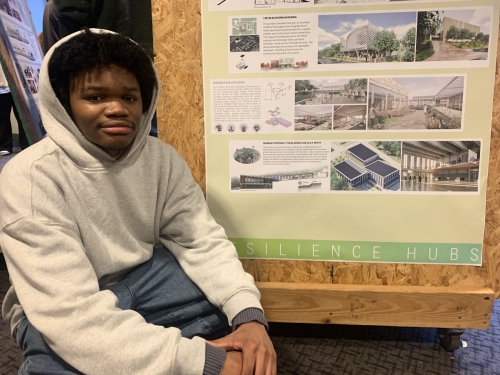
Gaddy and six of his classmates designed what are referred to as resilience hubs.
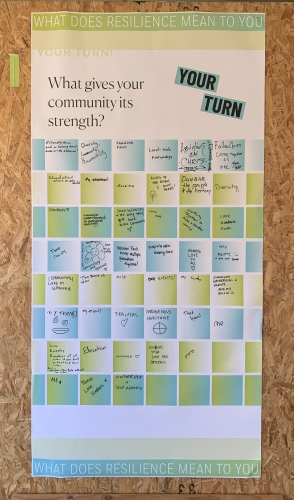
The idea was to design a neighborhood facility that can serve residents’ everyday needs as well as emergency needs and might include a community garden, food pantry, and gathering areas, but also provide water, shelter, and communications during times of crisis.
He’s “hoping that these projects serve as inspiration for potential solutions to an existing problem that we face. You usually think of emergency relief as like a separate entity that is only used during certain times of the year.”
But if the facility is in use year-round, when a crisis does arise, he hopes that tending to the community will be much simpler.
The students used the semester to implement what they’ve learned in their majors.
“This semester, we had architecture and industrial design,” says Lauren Harness, KCDC’s academic programs director and instructor. “Next semester, every discipline is represented, so regional community planning and interior and landscape architecture.”
She explains that the program started because a lot of students are not from large cities and lack an understanding of the issues faced in urban areas.
“It’s an important thing for designers to learn about urban design and urban context. A Kansas City-based design studio allows students to fully immerse themselves in urban design issues,” Harness says.
Student Colin Culbertson studied air quality, something he hadn’t looked into before.
“I actually came across that Kansas City is the 20th most affected city in the U.S. by air pollution. And so it really is a big problem, and I wasn't even really aware of it,” Culbertson says.
The resulting proposal is for a kiosk he calls “Awair,” a public air quality network, which he describes as “a family of devices that help communities recognize, react, and address air pollution by bringing understandable air quality information into shared public spaces.”
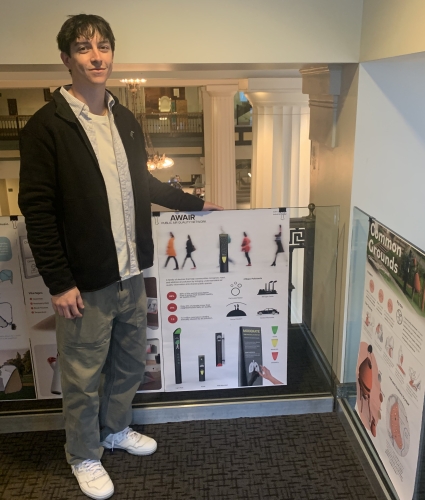
So, someone would be able to tap the animation on Culbertson’s kiosk screen to learn how heavily the air is polluted, by what, the possible health effects, and a solution.
He says he wanted to find “a way to make this common knowledge and make it so everybody has the access to the information and just bringing it in a simple way so they can see the graphics and understand pretty quickly that today is a moderate day, one day is a good day, one day is a bad day.”
Harness says the goal is for these very early ideas to become real projects down the line as has already happened with their work on the Kessler Park Reservoir, KCK housing revitalization, and West Bottoms redevelopment.
She says that the residents of Dunbar, situated just west of the Truman Sports Complex, identified a resilience hub as their top priority. The more than 130-year-old neighborhood has fallen into disrepair over the past 50 or so years due to loss of industry and natural disasters, and residents are working toward revitalization. The resilience hub is a significant step toward that.
The designs on display, Harness says, will act as “visioning to help fundraising or help refine what they're going to ultimately make their building look like.”